
What Is the Triple H Framework? Heritage, Health & Healing Explained

Updated: Jul 31
Introduction: A New Way of Understanding African Identity and Wellbeing
For generations, many people of African descent have experienced a disconnect between their heritage, health knowledge, and personal identity. Migration, colonial histories, disrupted family records, and limited access to genetic information have created gaps in understanding where people come from and how their ancestry influences their health.
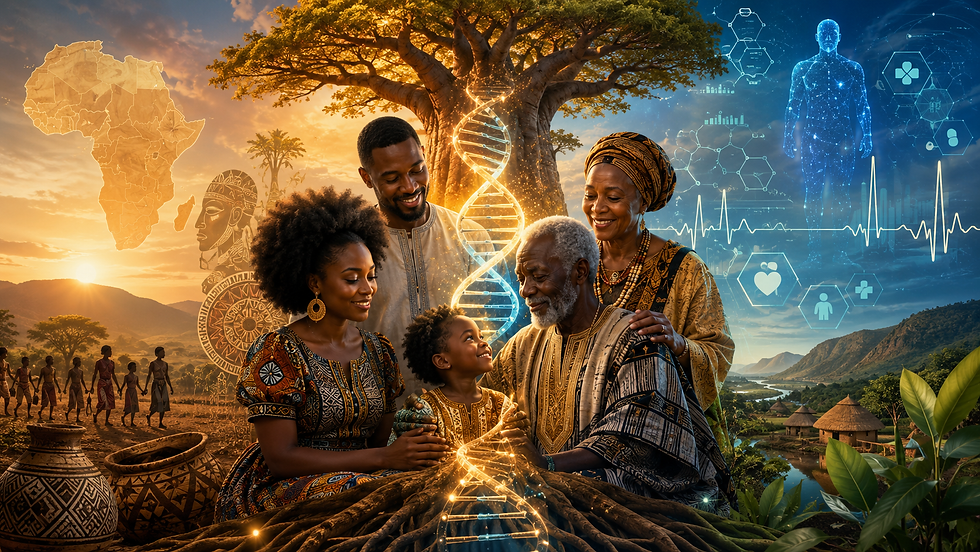
The TripleH Framework (Heritage, Health & Healing) provides a holistic approach that reconnects these three essential elements.
By combining African ancestry, genomic education, cultural identity, and community wellbeing, TripleH creates a pathway toward a future where Africans and the global African diaspora can better understand their roots, improve health awareness, and strengthen connections across generations.TripleH (3HHH): Africa's Heritage, Health & Healing App
What Is the TripleH Framework?
The TripleH Framework is an integrated model built around three interconnected pillars:
1. Heritage
Heritage represents our connection to the past — our ancestors, cultures, languages, traditions, histories, and family stories.
For many African families, traditional genealogy records were disrupted through historical events, migration, and social changes. As a result, many individuals today have unanswered questions:
Where did my ancestors originate?
Which communities am I connected to?
What cultural traditions are part of my identity?
How can I preserve my family's history?
Modern tools such as:
DNA ancestry analysis
genealogical research
oral history documentation
cultural archives
can help restore connections between individuals and their ancestral heritage.
Heritage is not only about knowing where we come from. It is about understanding the stories, resilience, and knowledge passed down through generations.
The Health pillar focuses on understanding the relationship between genetics, ancestry, and wellbeing.
Human DNA contains information inherited from generations before us. While genetics does not determine everything about a person's health, it can provide important insights into:
inherited health risks
genetic diversity
disease patterns
medication response
preventive healthcare opportunities
African populations contain some of the greatest genetic diversity in the world. However, African ancestry has historically been underrepresented in global genomic research.
This lack of representation affects:
accuracy of genetic studies
development of medicines
understanding of disease risks
access to precision healthcare
The TripleH Framework promotes genomic literacy so communities can understand DNA information responsibly and make informed health decisions.
Healing represents restoration — restoring identity, family connections, knowledge, and community wellbeing.
Healing within the TripleH Framework is not only medical. It includes:
Identity Healing
Many people experience uncertainty about their ancestry and cultural connections. Learning about family origins can strengthen belonging and identity.
Generational Healing
Understanding family histories allows communities to preserve stories, traditions, and knowledge for future generations.
Community Healing
Health challenges affecting African communities require collective solutions based on education, research, and equitable access.
Healing means reconnecting what history separated.
How Heritage, Health and Healing Work Together
The three pillars are connected:
             TripleH Framework

                 Heritage
                    |
                    |
Health -------------+------------- Healing
Heritage provides identity.
Knowing our ancestry creates a stronger understanding of who we are.
Health provides knowledge.
Understanding genetics helps individuals make informed decisions about wellbeing.
Healing provides restoration.
Reconnecting with identity and improving health knowledge strengthens communities.
Together, they create a complete approach to African wellbeing.
TripleH and African GenomicsThe DNA Gap: Why African Representation in Genetics Matters
African genomics is central to the TripleH Framework because DNA carries information about human history, migration, and biological diversity.
Africa is often described as the birthplace of humanity because modern humans trace their evolutionary origins to the continent.
Studying African genomes helps researchers understand:
human migration patterns
population history
genetic variation
disease biology
personalised medicine
However, African populations remain underrepresented in many genomic databases.
Increasing African participation in genomic research can contribute to:
better healthcare solutions
improved disease prediction
medicines designed for diverse populations
greater genomic equity
Why DNA Matters in the TripleH Framework
DNA can act as a bridge between past, present, and future generations.
Through DNA education and ancestry research, individuals may discover:
Ancestral Connections
DNA can provide clues about geographic and population origins.
Family Connections
Genetic genealogy can help identify relatives and rebuild family histories.
Health Insights
Genetic information can support conversations about inherited health risks.
The goal is not simply to discover genetic information, but to use knowledge responsibly to strengthen individuals and communities.
TripleH and the African Diaspora
Millions of people of African descent around the world seek deeper connections with Africa.
The TripleH Framework supports diaspora reconnection by combining:
ancestry discovery
cultural education
heritage preservation
genomic awareness
It creates opportunities for people to reconnect with African histories that may have been lost through displacement.
How AfriGenetry Link Applies the TripleH Framework
AfriGenetry Link uses the TripleH approach to connect:
Heritage
Through:
African ancestry research
genealogy support
cultural identity education
Health
Through:
genomic education
DNA awareness
health research participation
Healing
Through:
restoring family connections
preserving African stories
improving access to knowledge
The goal is to empower African communities with information that supports identity, health awareness, and future generations.
The Future of TripleH: Building an African-Centred Health Future
The future of healthcare will increasingly involve:
genomics
precision medicine
personalised prevention
community-based research
For Africa to benefit from these advances, communities must be represented and educated.
The TripleH Framework provides a foundation where ancestry, science, and culture work together.
It recognizes that health is not separate from identity — our history, environment, genetics, and communities all influence our wellbeing.
Frequently Asked Questions
What does TripleH stand for?
TripleH stands for:
Heritage, Health, and Healing.
It is a framework connecting ancestry, genomic health education, and community wellbeing.
Why is African genomics important?
African genomics is important because African populations contain significant genetic diversity. Increasing representation improves research accuracy and supports more inclusive healthcare.
Can DNA reveal African ancestry?
DNA ancestry testing can provide insights into ancestral origins and genetic connections, although results depend on available reference populations and scientific methods.
How does TripleH connect culture and science?
TripleH combines cultural heritage knowledge with modern genomic science to create a more complete understanding of identity and wellbeing.
Is TripleH only for Africans living in Africa?
No. The framework also supports the African diaspora by helping people reconnect with African ancestry, history, and identity.
Conclusion
The TripleH Framework — Heritage, Health & Healing — represents a new approach to understanding African identity and wellbeing.
By reconnecting ancestry, genomic knowledge, and community restoration, TripleH creates a pathway toward a healthier and more connected future.
Understanding where we come from can help us understand ourselves, protect future generations, and build a more inclusive health future for Africa and the world.
Scientific References & Further Reading
1. African Genetic Diversity & Human Origins
Article section:"Africa is often described as the birthplace of humanity because modern humans trace their evolutionary origins to the continent."
Citation:
Africa contains the greatest human genetic diversity, reflecting the deep evolutionary history of Homo sapiens on the continent.
Reference:
Tishkoff, S. A., et al. (2009).The Genetic Structure and History of Africans and African Americans.Science, 324(5930), 1035–1044.
2. Importance of African Representation in Genomic Research
Article section:"African populations remain underrepresented in many genomic databases."
Citation:
Individuals of African ancestry remain significantly underrepresented in human genomic studies, limiting the accuracy and inclusiveness of genomic medicine.
Reference:
Popejoy, A. B., & Fullerton, S. M. (2016).Genomics is failing on diversity.Nature, 538, 161–164.
3. African Genomics and Precision Medicine
Article section:"Increasing African participation in genomic research can contribute to better healthcare solutions."
Citation:
Greater inclusion of African populations in genomics can improve understanding of human variation and support more equitable precision medicine.
Reference:
H3Africa Consortium. (2014).Research capacity. Strengthening African genomics for health.Nature, 508, 22–23.
4. DNA Ancestry and Genetic Genealogy
Article section:"DNA can act as a bridge between past, present, and future generations."
Citation:
Genetic genealogy uses DNA variation to investigate biological relationships and ancestral origins.
Reference:
Royal, C. D., et al. (2010).Inferring Genetic Ancestry: Opportunities, Challenges, and Implications.American Journal of Human Genetics, 86(5), 661–673.
5. Genetics and Health Risk Understanding
Article section:"DNA can provide insights into inherited health risks."
Citation:
Genetic variation can influence susceptibility to certain diseases and responses to treatments, contributing to personalised healthcare approaches.
Reference:
Collins, F. S., & Varmus, H. (2015).A New Initiative on Precision Medicine.New England Journal of Medicine, 372, 793–795.
6. Cultural Identity, Heritage and Wellbeing
Article section:"Learning about family origins can strengthen belonging and identity."
Citation:
Connection to cultural heritage and ancestry can contribute to identity formation, belonging, and community wellbeing.
Reference:
UNESCO.Convention for the Safeguarding of the Intangible Cultural Heritage.
7. Indigenous and Community Participation in Genomics Ethics
Article section:"The goal is not simply to discover genetic information, but to use knowledge responsibly."
Citation:
Ethical genomic research requires community engagement, responsible data governance, and consideration of cultural contexts.
Reference:
The National Academies of Sciences, Engineering, and Medicine (2020).Understanding and Addressing the Underrepresentation of Women in Clinical Research.(General framework applicable to inclusion and equity principles.)
In-Article Citation
Africa contains some of the greatest genetic diversity in the world, reflecting deep population history and human evolutionary origins. (Tishkoff et al., 2009)
African populations remain underrepresented in genomic studies, creating challenges for equitable genomic medicine. (Popejoy & Fullerton, 2016)
Expanding African genomic research participation is important for developing globally representative precision medicine. (H3Africa Consortium, 2014)
Medical disclaimer: "Genomic information is educational and does not replace professional medical advice."
Author bio: Kenn Mangena — SEO, Website & Growth Lead, AfriGenetry Link


Comments